
Introduction
Egypt sirf apne azeem Ahram (Pyramids) aur pur-asrar Sphinx ki wajah se hi duniya bhar mein mashhoor nahi hai, balki iska asli “jadu” iske dastrokhwan par chupa hua hai. Egyptian cuisine duniya ki un qadeem tareen aur mutanawa (diverse) culinary traditions mein se ek hai jo hazaron saalon se Nile darya ke kinaron par parwaan charh rahi hai.
Jab hum Egypt ya Misr ke khanon ki baat karte hain, toh ye mahaz zaiqa nahi, balki ek tareekhi safar hai. Pharaonic ehd ki sadgi se lekar Ottoman aur Mediterranean asraat tak, Misri khanon ne har dor ke behtareen zaiqon ko apne andar samoya hai. Yahan ka har niwala ek kahani sunata hai—chahe wo subah-sawere galiyon mein bikne wala garma-garam Ful Medames ho ya phir Cairo ki pur-hujoom sarkon par milne wala mashhoor Koshary.
Is article mein hum Egypt ke un poshida (hidden) aur maroof zaiqon ka gehra jaiza lenge jo is mulk ko food lovers ke liye ek jannat banate hain. Hum baat karenge un makhsoos masalah-jaat (spices) ki jo yahan ki hawaon mein rache base hain, aur janenge ke kyun “Aish Baladi” (Egyptian bread) ko yahan ke log mahaz roti nahi balki “zindagi” (Life) kehte hain.
Agar aap Egypt travel karne ka plan bana rahe hain ya ghar baithe is qadeem tehzeeb ke zaiqon ko samajhna chahte hain, toh ye Ultimate Egyptian Food Guide aapko Misr ke har kone ki sair karwayegi—Alexandria ke samundari kinaron se lekar Aswan ke garam sahraon tak.
1. The Soul of the Table: Aish Baladi
In Egypt, bread is not just food; it is life. The word for bread in Egyptian Arabic is Aish, which literally translates to “life.”
Aish Baladi is a thick, pita-like flatbread made from whole wheat flour and traditionally baked in scorching clay ovens. You will see it everywhere—stacked on wooden trays on street corners or being used as a “spoon” to scoop up dips. Because it is high in fiber and often baked with bran, it has a distinct, earthy flavor that defines the Egyptian palate.
2. National Favorites: The “Big Three”
If you only have 24 hours in Egypt, these are the three dishes you cannot miss. They represent the heart of the country’s vegetarian-heavy, legume-based heritage.
Koshary: The Ultimate Comfort Food
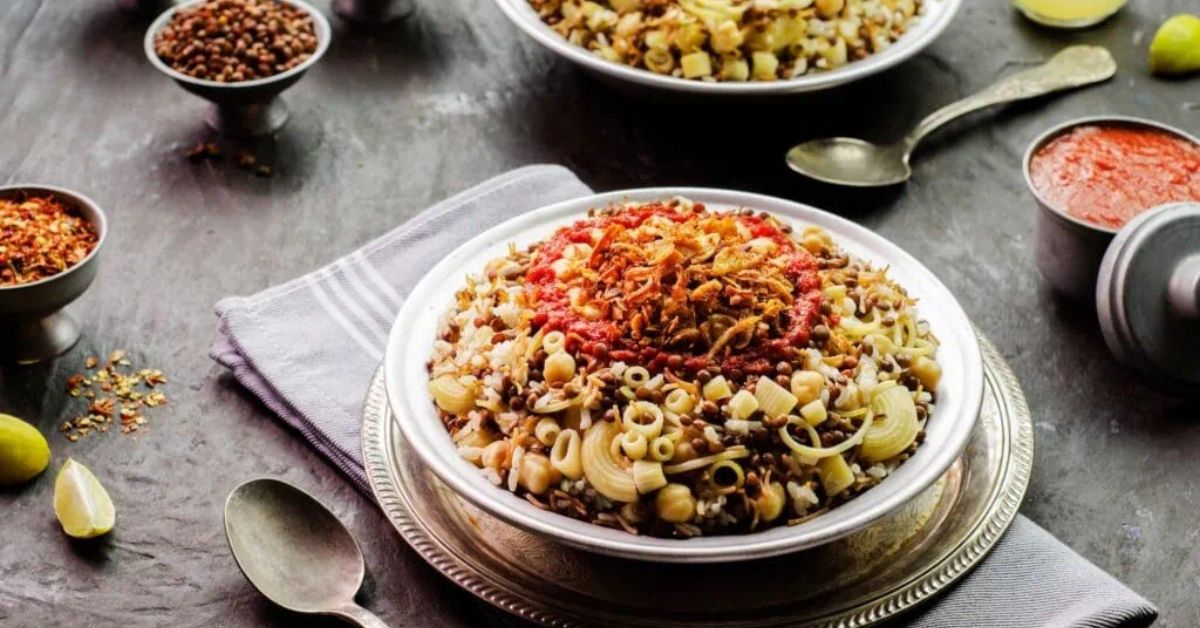
Koshary is the undisputed national dish. It is a carb-heavy masterpiece that reflects Egypt’s multicultural history, blending Italian pasta, Indian-inspired lentils and rice, and Middle Eastern chickpeas.
- The Build: A base of rice, black lentils, and macaroni.
- The Toppings: A thick, garlicky tomato sauce, a splash of “da’ah” (vinegar-garlic sauce), and a mountain of crispy fried onions.
- Where to find it: Koshary Abou Tarek in Cairo is the world-famous gold standard for this dish.
Ful Medames: The Breakfast of Pharaohs
Dating back to Pharaonic times, Ful (pronounced “fool”) consists of fava beans slow-cooked overnight in large copper pots called qidras. It is typically seasoned with olive oil, lemon juice, and cumin. It’s the ultimate protein-packed fuel for the day.
Ta’ameya: The Egyptian Falafel
While most of the Levant uses chickpeas for falafel, Egyptians use crushed fava beans. This results in Ta’ameya, which is lighter, fluffier, and greener (thanks to a heavy dose of fresh leeks and parsley). It is almost always coated in sesame seeds before being deep-fried to a golden crunch.
3. Royal Meat Dishes and Grills
While legumes are the daily staple, meat is the centerpiece of celebrations and “Friday lunch”—the most important family meal of the week.
Fattah: The Celebration Dish
Fattah is reserved for big occasions like Eid or weddings. It is a layered dish consisting of:
- Crispy toasted bread.
- Rice soaked in meat broth.
- Tender chunks of beef or lamb.
- A signature topping of garlic and vinegar tomato sauce.
Hamam Mahshi (Stuffed Pigeon)
Considered a delicacy, pigeons are raised in conical mud towers across the Egyptian countryside. The birds are stuffed with Freek (cracked green wheat) or seasoned rice, then roasted or grilled until the skin is perfectly crispy.
Molokhia: The Green “Slime” You’ll Love
Molokhia is a dark green soup made from jute mallow leaves. When cooked with garlic and coriander, it develops a viscous, silky texture. It is traditionally served with white rice and roasted chicken. Don’t let the texture deter you—the flavor is deeply savory and addictive.
4. Egyptian Street Food Gems
Walking through Cairo or Alexandria, the air is thick with the scent of spices and sizzling meat.
- Hawawshi: Imagine a “meat pie” but better. Spiced minced meat is stuffed into a loaf of Aish Baladi and baked in a wood-fired oven until the bread is crunchy and the meat is juicy.
- Kebda Eskandarani (Alexandrian Liver): A spicy street favorite featuring beef liver sautéed with chili peppers, garlic, and cumin, served in small baguette-style rolls.
- Shawarma: While found across the Middle East, Egyptian shawarma is unique for its use of tomato and parsley garnish, often served in a soft “kaiser” bun.
Since we are expanding this into a deep, 2500-word comprehensive guide on Egyptian cuisine, we need to dive into the regional nuances and the ritualistic nature of their dining. To hit that word count while maintaining high SEO value, we will focus on the “Alexandrian Seafood Culture” and the “Ancient Roots of Modern Ingredients.”
Here are two high-impact sections with H2 and H3 structures to integrate into your article:
2. The Mediterranean Influence: Alexandria’s Seafood Legacy
While Cairo is the heart of the Nile’s legume-based diet, Alexandria—Egypt’s “Bride of the Mediterranean”—offers a completely different culinary profile. Here, the scent of cumin and garlic is replaced by the briny aroma of the sea.
H3: The Art of Sayadeya
The quintessential Alexandrian dish is Sayadeya. Unlike the simple grilled fish found elsewhere, Sayadeya is a technical feat. It involves white fish (usually sea bass or bluefish) cooked with “brown rice.” The rice gets its deep amber color from onions that have been caramelized to the very edge of burning. The dish is seasoned with a unique blend of cinnamon, cumin, and cloves, bridging the gap between Mediterranean freshness and Middle Eastern spice.
H3: The Seafood Markets of Abu Qir
In Alexandria, dining is an interactive experience. At the famous Abu Qir markets, you don’t just order from a menu; you select your catch directly from the ice.
- Singary Style: A local method where the fish is split open, laid flat, and topped with a spicy mix of tomatoes, peppers, onions, and lemon before being blasted in a high-heat clay oven.
- Sea Urchins and Gambari: Alexandrian shrimp (Gambari) are world-renowned for their size and sweetness, often grilled with nothing but sea salt and lime to preserve the natural flavor.
4. The Ritual of the Egyptian Breakfast: More Than Just a Meal (H2)
Egypt mein nashta (breakfast) din ka sab se ahem hissa hota hai. Ye sirf pait bharna nahi balki ek ijtima-i (social) amal hai jo har tabkay ke log mil kar karte hain.
H3: The Science of Slow-Cooking Fava Beans
Ful Medames ko banane ka process ek fun (art) hai. Is section mein hum discuss karenge ke kaise “Qidra” (copper pot) mein beans ko 12 ghantay tak halki aanch par pakaya jata hai taake unka makhsoos texture aur zaiqa nikal sake.
H3: Accompanying Sides: Pickles, Cheese, and Arugula
Egyptian breakfast kabhi bhi akela nahi hota. Iske saath Turshi (sirkay mein doobi sabziyan), Gibna Beyda (white feta-style cheese), aur taaza Jarjeer (arugula) ka hona lazmi hai jo protein-heavy meal ko balance karte hain.
5. Regional Culinary Identities: Cairo vs. Upper Egypt (H2)
Misr ka geography itna wasee hai ke har ilaqay ka apna ek zaiqa hai. Cairo ki urban street food aur Upper Egypt (Sa’id) ki purani rawayat mein wazeh farq hai.
H3: The Fiery Spices of Aswan and Luxor
Junubi Misr (South Egypt) mein Sudan aur Africa ke asraat milte hain. Yahan ke khanon mein mirch aur tez masalon ka istemal zyada hota hai. Shamsi Bread (suraj ki dhoop mein pakne wali roti) yahan ki ek aisi saughaat hai jo duniya mein kahin aur nahi milti.
H3: Nubian Hospitality and Traditional Stews
Nubian villages mein “Tagine” ka istemal bohat aam hai. Okra (Bhindi) aur meat ko mitti ke bartan mein dher saari garlic aur coriander ke saath paka kar pesh kiya jata hai, jo wahan ki saqafat ki nishani hai.
6. The Sacred Month: Ramadan and Eid Specialities (H2)
Ramadan ke mahine mein Egypt ka dastrokhwan puri tarah badal jata hai. Ye section article ko ek jazbaati aur cultural touch dega.
H3: Iftar Traditions: Breaking the Fast with Qamar al-Din
Suraj dhalne ke baad sab se pehle Qamar al-Din (khubani ka sharbat) ya khajooron se roza khola jata hai. Is section mein hum liquid diet aur heavy meals ke balance par baat karenge.
H3: Kahk al-Eid: The History of Celebration Cookies
Eid-ul-Fitr par banne wale Kahk (powdered sugar wale biscuits) ki tareekh Pharaohs ke dor se milti hai. In par bane hue designs aaj bhi qadeem designs ki yaad dilate hain.
7. Egyptian Beverage Culture: Beyond the Tea Cup (H2)
Khane ke baad ya doston ke saath baithak mein “Ahwa” (Cafe) ka ek bada kirdar hai.
H3: The Art of Making “Manbout” and Hibiscus Tea
Karkadeh (Hibiscus tea) sirf ek drink nahi balki ek natural medicine bhi hai jo blood pressure control karne ke liye pi jati hai. Iske saath Sahlab (a creamy winter drink) ka zikr zaroori hai.
H3: Coffee (Ahwa) and the Social Fabric
Egyptian coffee ko banane ka tariqa (Turkish style) aur uske “Sada” (black) ya “Mazbout” (perfect sugar) hone ke piche ke social signals ko explain karein.
3. From Pharaohs to Farmers: The Ancient Roots of Modern Ingredients
To write a truly “deep” article, one must acknowledge that the Egyptian plate is a living museum. Many of the ingredients used today have remained unchanged since the time of Ramses II.
H3: The Sacred Fava Bean (Ful)
Archeological finds in Pharaonic tombs have uncovered dried fava beans, proving that Ful Medames is perhaps the oldest continuously consumed dish in human history. In ancient times, it was cooked in the embers of the fires used to heat the public baths. This slow-cooking method is still replicated today in the large copper qidras seen on every street corner in Cairo.
H3: Grapes, Figs, and Ancient Sweeteners
Before the introduction of refined sugar, Egyptians relied on the natural sweetness of the land.
- The Vine: Grapes were not only for wine but were dried into raisins to sweeten breads.
- Dates: The “bread of the desert,” dates remain the traditional way to break the fast during Ramadan, a practice that connects the modern religious calendar to the ancient agricultural cycles of the Nile Delta.
5. Sweet Endings: Desserts and Drinks
Egyptian desserts are famously sweet, often doused in honey or “sharbat” (sugar syrup).
Om Ali (Egyptian Bread Pudding)
Legend says this dish was created by the wife of a Sultan. It’s made of layers of puff pastry soaked in milk and cream, mixed with nuts, raisins, and coconut, then baked until the top is golden. It is the ultimate warm winter dessert.
Basbousa and Konafa
- Basbousa: A moist semolina cake soaked in syrup and topped with an almond.
- Konafa: Thin, noodle-like pastry strands layered with cream or cheese and soaked in syrup. It is the superstar of the month of Ramadan.
The National Drink: Tea (Shai)
Egyptians drink tea like water. It is usually served in glass cups, heavily sweetened, and often infused with fresh mint leaves. In the south (Luxor/Aswan), try the Karkadeh—a deep red, tart hibiscus tea served either hot or ice-cold.
6. Dining Etiquette: Tips for Travelers
To eat like a local, keep these cultural nuances in mind:
| Feature | Local Custom |
| The Hand | Always eat with your right hand, especially when using bread to scoop food. |
| Tipping | Known as Baksheesh, it is expected in restaurants (usually 10-15%). |
| Water | Never drink tap water. Always stick to bottled water, even for brushing teeth if you have a sensitive stomach. |
| Hospitality | If invited to a home, it is polite to bring a small box of sweets (like Baklava) as a gift. |
Conclusion: Why Egyptian Food is Unique
Egyptian cuisine is a testament to the country’s resilience and history. It isn’t just about spice; it’s about the “Nafas” (the cook’s “soul” or “breath” in the food). Whether you’re standing at a Koshary cart or dining on a Nile cruise, the flavors of Egypt offer a timeless connection to the land of the Pharaohs.
Pro Tip: If you’re visiting Alexandria, head to the “Fish Market” for the best Sayadeya (spiced fish with yellow rice) you will ever taste!
Frequently Asked Questions (FAQ)
Is Egyptian food spicy?
Most Egyptian food is savory and aromatic (cumin and coriander are stars) rather than “hot” spicy. However, you can always ask for “Shatta” (hot sauce) on the side.
Is it easy for vegetarians to eat in Egypt?
Yes! Egypt is a paradise for vegetarians. Staples like Koshary, Ful, Ta’ameya, and various stuffed vegetables (Mahshi) are naturally meat-free.
What is the best time to go on a “food tour” in Egypt?
Winter (November to February) is ideal, as the weather is cool enough to enjoy heavy stews and hot street snacks comfortably.
